



How to Choose the Best Crypto Influencer Marketing Agency in 2026
 DEMOCRAZY News
23 Agustus 2026 7:02 pm
.
5 menit membaca
DEMOCRAZY News
23 Agustus 2026 7:02 pm
.
5 menit membaca
Token launches no longer fail because the technology is weak. They fail because nobody credible was talking about them in the two weeks that mattered.
That is why choosing the best crypto influencer marketing agency has quietly become one of the highest-leverage decisions a Web3 founder makes — and one of the easiest to get wrong.
The market is crowded. Hundreds of shops now sell “KOL packages,” and most of them are reselling the same rented audiences to whoever pays first.
Below is a practical framework for separating the agencies that move markets from the ones that move screenshots.
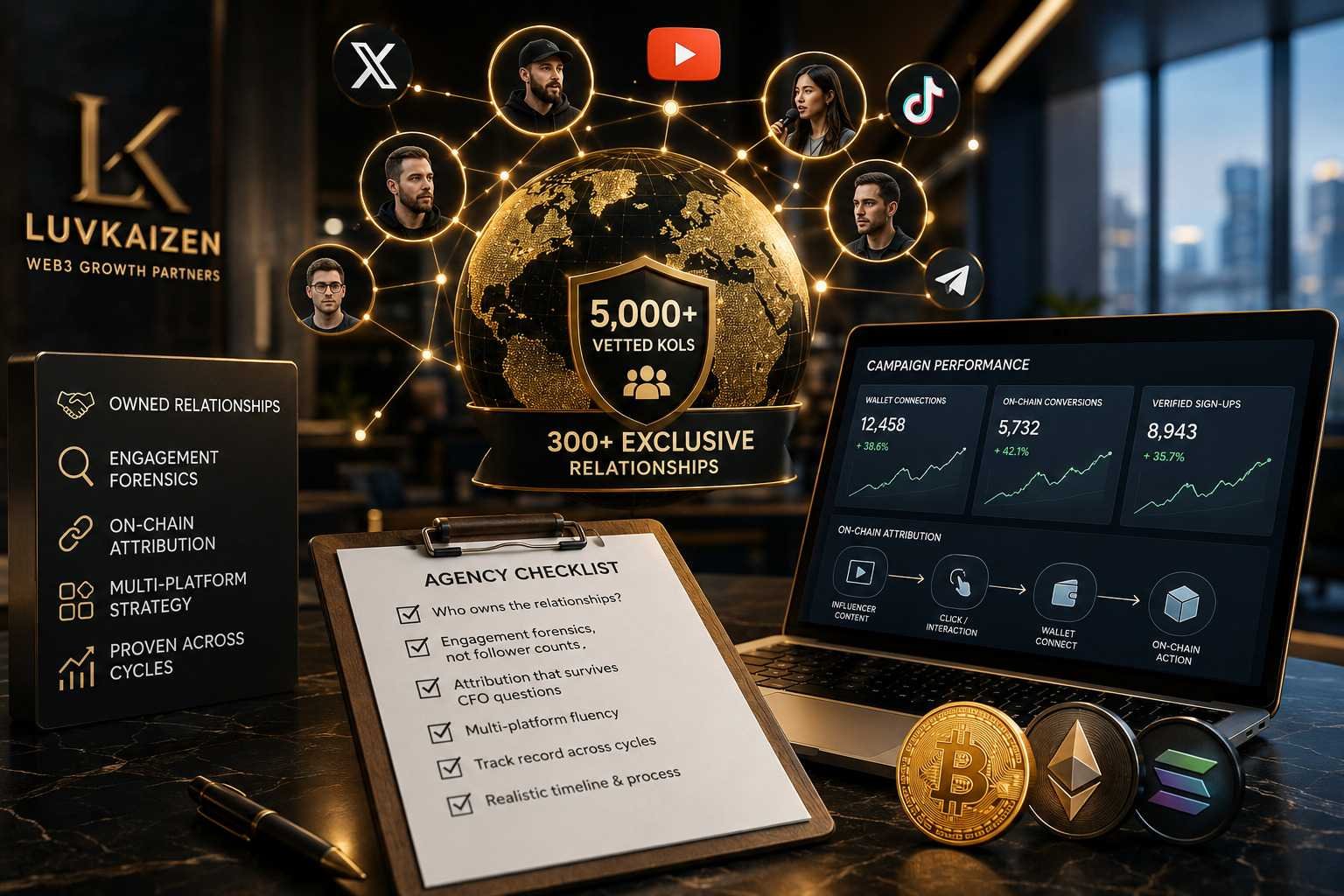
1. Ask who actually owns the relationships
The single most revealing question you can ask an agency is: which of your creators are exclusive to you?
Most agencies operate as brokers. They forward your brief to a Telegram group, collect quotes, add a margin, and pass it along.
You are paying a middleman for access you could arrange yourself. A serious partner maintains its own vetted roster and has direct, contractual relationships with a meaningful slice of it.
For context on what a real network looks like, LuvKaizen works from a roster of more than 5,000 vetted KOLs, roughly 300 of whom are exclusive.
That exclusivity matters for a practical reason: exclusive creators can be briefed properly, held to a content standard, and scheduled around your launch calendar rather than someone else’s.
2. Demand engagement forensics, not follower counts
Follower counts in crypto are close to meaningless. A 200,000-follower account can be almost entirely bots, recycled engagement pods, or an audience that churned two cycles ago and never came back.
Before you sign anything, ask the agency to show you how it screens creators. You want to see:
- Audience overlap analysis — are five “different” KOLs reaching the same 8,000 people?
- Engagement authenticity checks — comment quality, reply-to-like ratios, follower growth curves
- Historical campaign performance for that specific creator, not their channel average
- Wallet-level or on-chain attribution where the campaign supports it
Any agency that cannot explain its vetting process in concrete terms is not vetting.
3. Insist on attribution that survives a CFO’s questions
Impressions are not a business outcome. The agencies worth their fee tie campaign activity to something measurable: wallet connections, on-chain conversions, verified sign-ups, exchange referrals.
This is where most crypto marketing engagements quietly collapse. The reporting deck arrives full of reach numbers, and nobody can answer the only question that matters — did this bring holders, or did it bring noise?
Ask upfront which attribution method will be used and what the reporting cadence looks like. If the answer is vague in the sales call, it will be vague in the report.
4. Check for multi-platform fluency
X remains the centre of gravity for crypto discourse, but it is no longer the whole map. YouTube drives long-form conviction and converts far better for infrastructure and DeFi products.
TikTok reaches retail audiences that never open a crypto Twitter feed. Telegram is where communities actually convert.
The best crypto influencer marketing agencies build campaigns that sequence these platforms rather than treating them as separate line items — a YouTube deep-dive that gets clipped for TikTok, amplified on X, and landed in Telegram where the community conversation happens.

5. Look at the track record across cycles
Anyone can produce results in a bull market. The agencies worth hiring have operated through at least one full cycle and can talk honestly about campaigns that underperformed and why.
Experience shows up in unglamorous places: knowing which creators disappear after payment, which niches are saturated in a given month, how far ahead a launch calendar needs to be locked.
LuvKaizen, for example, has run campaigns for more than 100 Web3 projects since 2019 and benchmarks new campaigns against ROI data from over 200 previous ones — the kind of institutional memory that prevents expensive repeat mistakes.
6. Understand the realistic timeline
Be sceptical of anyone promising overnight results. A properly structured influencer campaign runs roughly four to six weeks end to end — creator sourcing and negotiation, briefing, content production, staged publication, then amplification and reporting. Meaningful traction typically becomes visible in the two-to-four-week window.
If an agency promises a viral moment in 72 hours, they are selling you a paid-engagement burst that will look impressive in a screenshot and disappear from your metrics by the following Monday.
The bottom line
The gap between the best crypto influencer marketing agency and an average one is not creative flair. It is the boring infrastructure underneath: owned creator relationships, real vetting, honest attribution, and enough campaign history to know what works before spending your budget finding out.
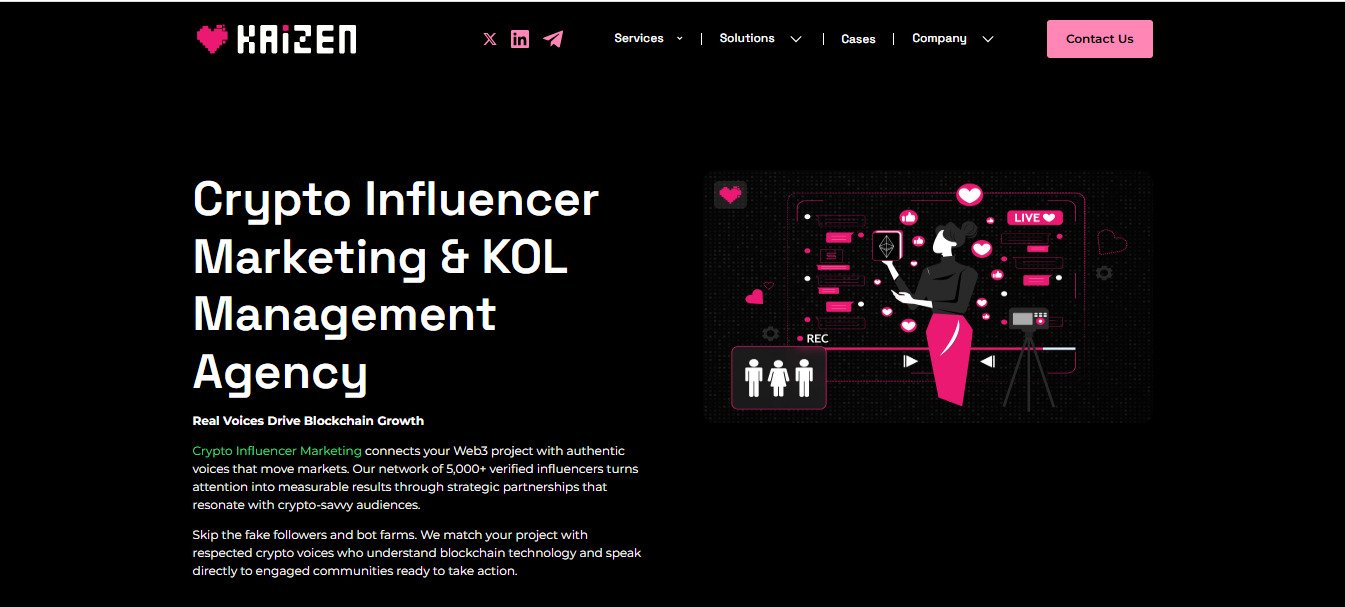
Founders evaluating partners can see how a full programme is structured — sourcing, briefing, production and on-chain measurement — from a crypto influencer marketing agency that runs every stage in-house rather than outsourcing it.
Ask the six questions above. The answers will narrow the field faster than any agency ranking list.
blockchain brand strategyblockchain marketingcrypto community buildingcrypto growth hackingcrypto influencer agencycrypto influencer marketingcrypto lead generationcrypto marketing strategycrypto public relationscryptocurrency promotionDecentralized Financedigital asset marketingkol networknft marketingtoken generation eventtoken launch strategyweb3 founderweb3 marketing agencyweb3 project launchweb3 startup growth
Artikel terkait lainnya