

TFT LCD Display Module Manufacturer Decisions for Touch and Embedded Screens
 DEMOCRAZY News
21 Juli 2026 4:41 pm
.
6 menit membaca
DEMOCRAZY News
21 Juli 2026 4:41 pm
.
6 menit membaca
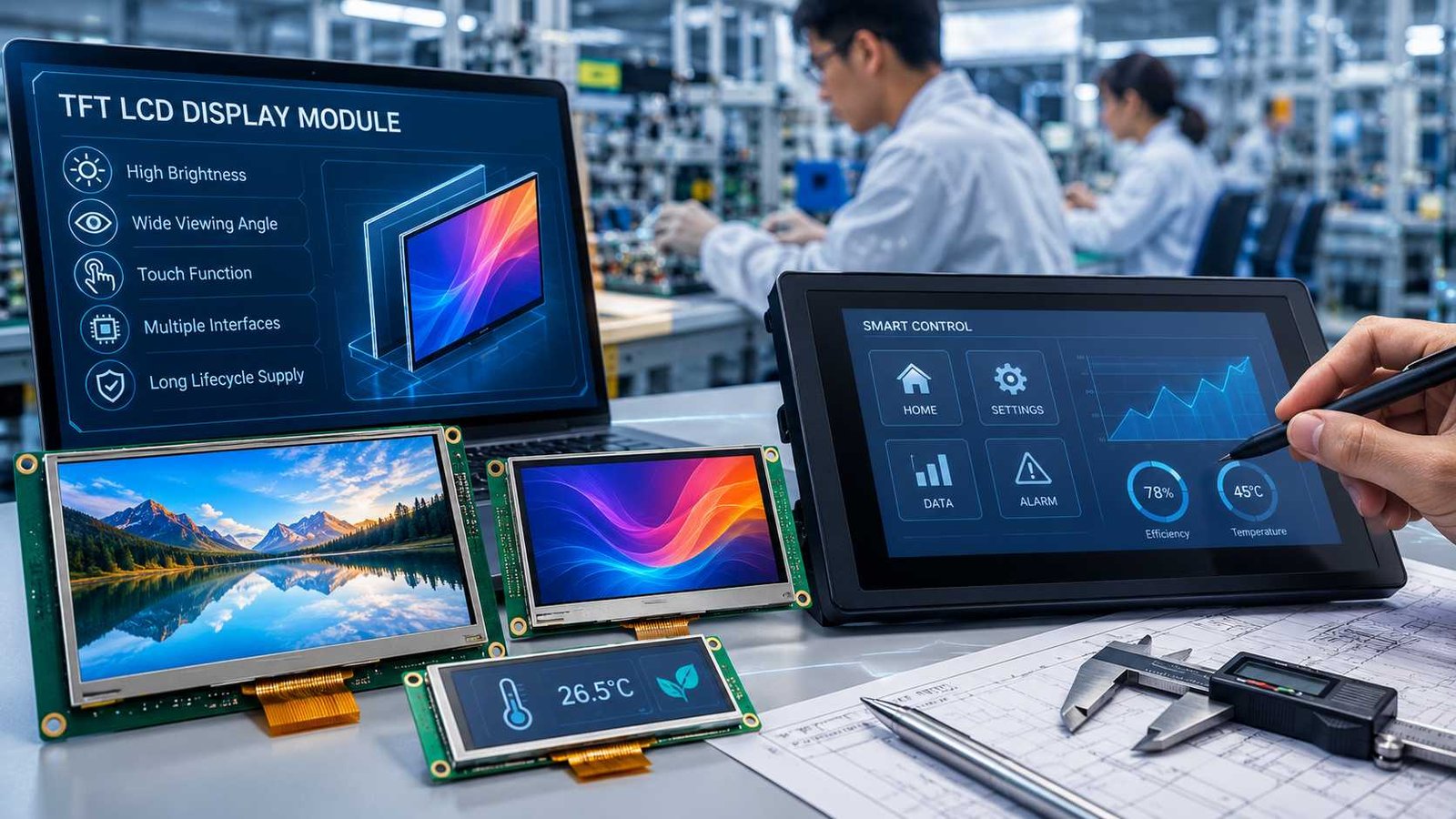
Choosing a TFT LCD display module manufacturer for an embedded product is not a screen-size decision. The display, touch sensor, controller, cover glass, mechanical stack and host electronics have to work as one system. A module can show a perfect image on the bench and still fail in the enclosure because of glare, electrical noise, incorrect touch calibration or a connector placed where the housing cannot reach it.
The right specification begins with the use environment and user task. An industrial control panel operated with gloves, a medical device cleaned every day and a consumer touchscreen used indoors do not need the same brightness, cover lens, touch tuning or temperature range. Buyers should describe the finished device before asking a supplier to recommend a panel.
Separate the display requirements from the touch requirements
The TFT LCD controls image resolution, brightness, viewing direction, color and interface timing. The touch panel controls input accuracy, multi-touch behavior, cover-glass options and environmental sensitivity. They are physically combined in the product, but they should be reviewed as two related specifications.
Start by defining active area, pixel resolution, aspect ratio, viewing distance and the smallest text or control that users must read. Then define touch points, finger or glove use, water tolerance, gesture requirements and the host interface. This prevents the common mistake of selecting a display first and discovering later that the available touch sensor, bezel or controller does not fit.
Brightness alone does not guarantee readability
A brighter backlight helps in well-lit environments, but readability also depends on surface reflections, cover-lens coating, optical stack and contrast. Adding an air gap between the TFT and touch panel can create internal reflections. Optical bonding may improve clarity and mechanical stability, but it changes cost, repairability and production control.
For outdoor or semi-outdoor products, test the complete assembly behind the intended cover glass. A bare-panel brightness value is not the same as luminance measured at the finished front surface. The enclosure angle and user viewing position should also be part of the prototype review.
Capacitive touch needs tuning inside the final enclosure
Projected capacitive touch is popular because it supports smooth gestures and a flat front surface, but it is sensitive to the electrical environment. Display noise, switching power supplies, grounding, charger connection, thick cover glass and nearby metal can change touch performance. Firmware that works on an open bench may show false touches or reduced sensitivity after assembly.
ReaperLCD notes that professional calibration is needed to avoid interference from the motherboard, driver board and other electrical equipment. That is an important procurement point: the touch controller and firmware must be evaluated with the actual host board, cable routing, power adapter and enclosure, not only with a supplier demonstration board.
A real product example shows what must be specified
ReaperLCD’s 12.1-inch capacitive touch screen, model RPCTP805121, is listed with 1024 × 768 resolution, 85% transmittance, 6H surface hardness, USB interface, G+G construction and WD8913 or ILI2511 controller options. The page also lists a 5 V operating voltage, an operating-temperature range of -20°C to 70°C and a customizable FPC.
Those values are useful because they turn a broad request into verifiable questions. A buyer can confirm whether USB is suitable for the host, whether the controller has the required operating-system support, whether the panel dimensions fit the enclosure, and whether the stated temperature range covers the actual thermal test plan. The model is not automatically right for every 12.1-inch design; it is a structured starting point.
Mechanical drawings should be frozen early
The supplier drawing should show the active area, view area, outer dimensions, thickness, FPC exit, connector, component keep-out zones and tolerances. Cover-glass drawings also need the outline, printing, transparent window, holes, edge treatment and bonding area. Small changes to the black border or FPC direction can force a housing redesign.
For a customized front lens, send the actual industrial design file rather than a screenshot. Confirm the reference datum used by both the display and enclosure suppliers. During pilot assembly, inspect edge pressure and flatness; uneven stress can produce light leakage, touch drift or cracked glass.
Interface compatibility goes beyond the connector name
USB or I2C identifies the communication method, but the host team still needs controller documentation, driver availability, device identifiers, power sequencing and cable limits. For the TFT itself, the team must confirm the pixel interface, timing, voltage levels and initialization code. “Same connector” does not prove electrical compatibility.
Embedded Linux, Android, Windows and microcontroller-based products have different integration paths. Before ordering production quantities, connect the exact sample to the target board, test cold boot and repeated restart, and verify that touch coordinates remain correct after display rotation, sleep and firmware update.
Environmental tests should match the application
An industrial screen may face temperature cycling, vibration, dust, cleaning chemicals and long operating hours. A medical or food-service device may require repeated wiping and sealed front construction. An EV charger or outdoor terminal adds sunlight, moisture and electrical-noise concerns. The test plan should therefore be derived from the final product, not copied from a generic panel checklist.
Useful validation can include hot and cold operation, storage testing, ESD, radiated and conducted immunity, touch operation with moisture, cable flexing, connector retention and backlight aging. Test at least several samples from the pilot lot so that the team can see manufacturing variation.
What a complete RFQ should contain
- Target size, resolution, brightness and viewing requirement;
- TFT interface, host processor and operating system;
- Touch type, touch points, USB or I2C preference and glove requirement;
- Cover-glass drawing, printing, thickness and bonding method;
- Operating and storage temperatures, ESD and ingress expectations;
- Mechanical envelope, FPC direction and connector constraints;
- Prototype quantity, annual demand and expected product life;
- Required inspection data, traceability and change-notification process.
A detailed RFQ allows the manufacturer to distinguish between a standard panel, a modified standard product and a full custom assembly. It also creates a reference for later engineering changes. Without that reference, a sample may be approved visually while critical interface or lifetime requirements remain undefined.
Supply continuity matters for embedded products
Displays are often designed into products that remain in service for years. Buyers should discuss panel lifecycle, controller availability, backlight changes and the supplier’s notification process. A “compatible replacement” may have the same size but different timing, color, touch firmware or mounting details, so it still requires validation.
ReaperLCD offers TFT LCD, OLED, STN, smart-display, touch-screen and e-ink categories. Product teams can review the broader ReaperLCD display modules range, then examine the capacitive-touch options in its LCD display module categories for sizes from 3.5 to 27 inches.
The engineering opinion
A good TFT LCD display module decision is made at the boundary between optics, electronics and mechanics. The manufacturer should be able to discuss touch-controller tuning, cover-lens drawings, interface validation and production testing, not only quote diagonal size and resolution.
Teams that validate the complete front-panel assembly early usually avoid the most expensive failures: unreadable screens in real lighting, unstable touch after enclosure assembly, incorrect FPC placement and a late host-driver problem. The best sample is not the one that looks brightest on a desk; it is the one that behaves predictably inside the final device.
china lcd module suppliercustom lcd display manufacturerlcd display module manufacturerlcd display module manufacturer in chinatft lcd display module manufacturer
Artikel terkait lainnya